While some of these quotes might help you start your work – be it an assignment, or quiz/exam preparation-, I would advice you to have some long term plan to help reduce your dependence on motivation for doing work or studying.
As you might have experienced, relying too much on motivation can prove sometimes to be less reliable, especially when specific conditions happen like you are physically tired requiring sleep. Other times it’s just you are not in the mood to study.
In order to avoid wasting time in such situations, it is best to start learning and reading on how you actually make a long term plan to reduce your dependence on motivation for studying.
But anyway, let’s start with our first quote.
Surviving everyday struggles in order to barely pass a course can be hard. It can seem like it’s a never ending struggle.
What you look at when you feel down, hopeless, tired , is for something that can ignite your motivation. This is what today’s post is about. So we will go through a few quotes about learning for students.
1- “In the end we retain from our studies only that which we practically apply.” — Johann Wolfgang Von Goethe
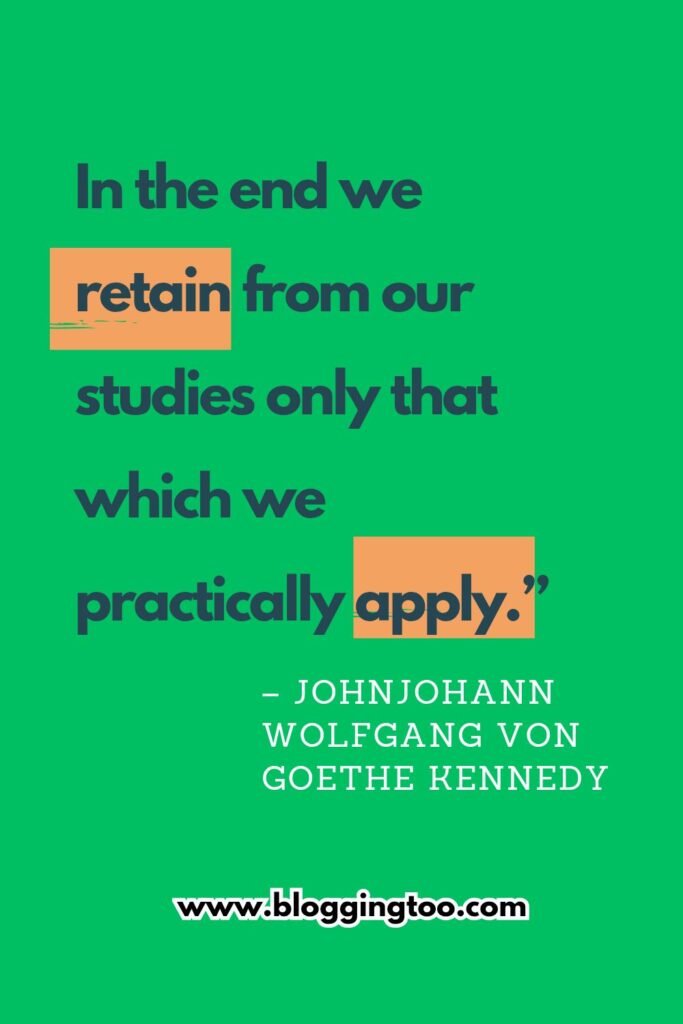
His quote highlights an important life experience he discovered, that applying the knowledge you learn is the best way to actually effectively learn. His quote provides the fundation to a better question, one that everyone wants to learn it’s answer. This question is how do we actually learn? How can someone learn. Well the easier answer according to him is to apply the knowledge. However If you want to know the longest answer , refer to my article about how to learn more effectively.
It should be noted that Johann Wolfgang was a man of many trades. He lived in the 18th century. He was a poet, novelist, scientist, statesman and a theatre-director among other things.
2-
“The great aim of education is not knowledge but action.”—Herbert Spencer
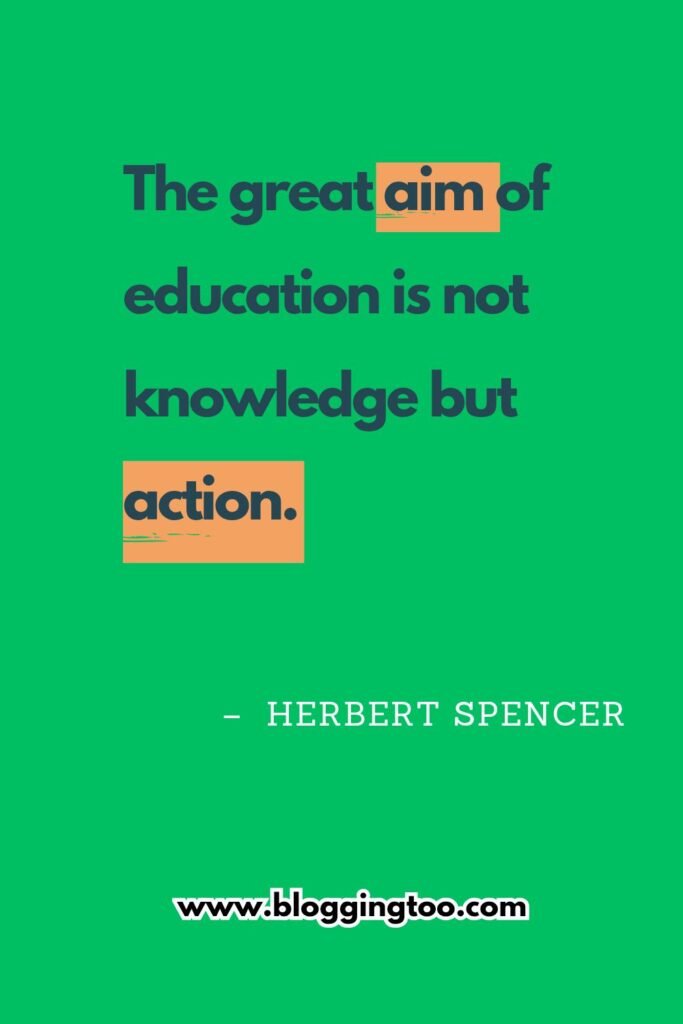
What is the purpose of education?
While the answer to this can be a standalone article by itself, a short answer according to U.S department of education is that the aim of education is to promote people to aquire knowledge and skills which can help them becoming successful members of the society.
Being a useful member of society is usually correlated with working a benefial job. The logic can go further that working in a job beneficial to society will lead to high salary. But this is not always the truth or at least not always apparent.
But let’s not focus too much on the big picture and we focus more on how can this quote help you?
By guiding you to focus on applying the knowledge you learn.
Don’t just memories At the end of the day, if you don’t use or apply your knowledge, you will most probably forget about it.
3-
“A well-educated mind will always have more questions than answers.” – Helen Keller
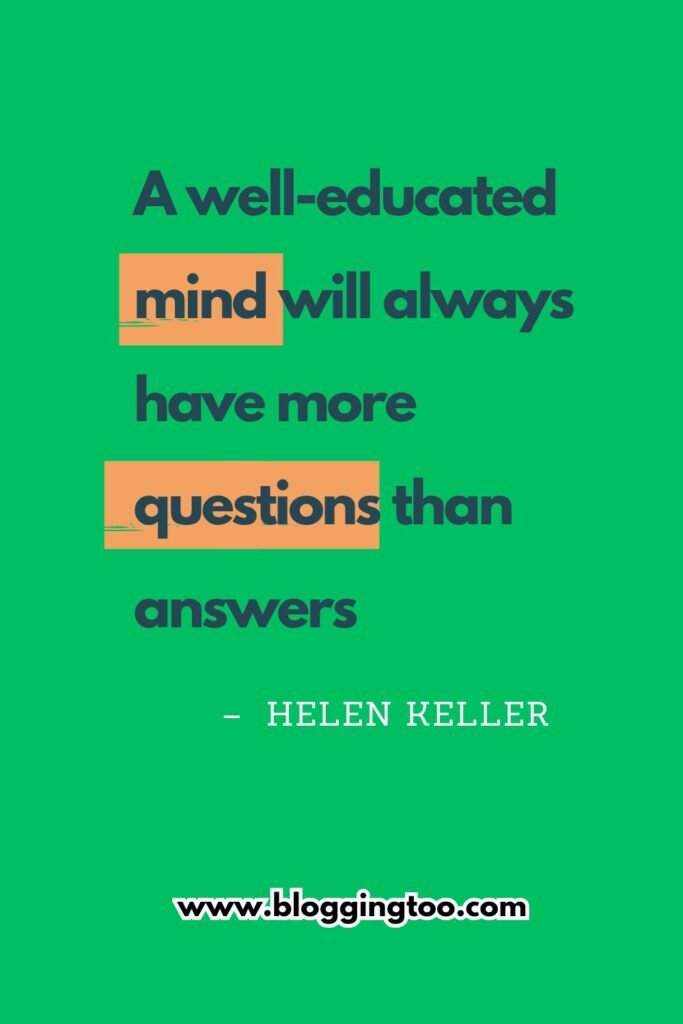
Helen Keller is an American author who wrote about 14 books in her lifetime on broad topics.
Her quote is something that any person can notice, the more you know a topic, the more questions you will have about that topic. I believe the same is true for all people, the more knowledge you aquire, the more you know what you don’t know, and therefore the more questions you will have.
An interesting observation I noticed that when a lecturer ask their students if they have any questions, silence is the reaction you will observe.
More often than not, students feel that when they ask questions they are effectively showing they are stupid among their classmates.
However what a lot miss is that the sole act of asking questions is the only way to advance your knowledge about the topic.
You , the one asking questions, keep asking questions, as this is what will make you understand the topic you are studying.
And You, the one who stays quiet, please think about this, and try asking more questions. Don’t care about your classmates, you are much better than them by the sole act of asking questions.
4-
” Every action you take is a vote for the type of person you wish to become.” —James Clear
James Clear is the author of the astonishing book that you should have heard about so far “Atomic Habits”. If you haven’t heard about this book, I have to say, you might be missing a lot.
So what does he mean by that?
Throughout the years you lived so far, you have built an identity about who you are, and the expectations, habits, and the goals this identity is associated with.
When you are looking to change yourself, or let’s say a specific habits you go through, it means you are trying to change a piece of the identity you have in your mind.
Change is hard, when you want to shift your whole life, without working on changing the expectations you have about this identity that comes with that change.
James Clear, says that each small actions you take towards the identity you want, is like a vote in favor of this new improved or worse self that accumulates by time to build it.
You think you want to be a hardworking, high-achieving student, but throughout the day you take actions that are proving to yourself that you are, in fact, a lazy, low-achieving student.
Each small action you take throughout the day that aligns with that identity of being hard working, high achieving student, are actually a confidence boost to yourself that proves at the end of the day that you are a hard working student, high achieving student.
People do not decide their future, they decide their habits, and their habits decide their futures. – Frederick Matthias Alexander
While what Fredrick pointed out is obvious, most of us are unaware of how much our future is literally shaped by the habits we adopt.
Small easy daily habits with positive impact, can accumulate into large positive consequences with enough time.
Application wise in your life as a student can be something I have experimented with preciously. Something as small as reading the lecture notes, before you go to a lecture few times can have an extremely big effect on how much you can understand from that lecture.
On the long run over a trimester, you might be able to have an easier time at exam preparation, if you integrate reading the lecture notes the same day you learn them through your lecturer. Forming a new habit might take as little as 4 days, and as much as 335 days, but on average 54 days according to some studies.
“Your life does not get better by chance, it gets better by change.” – Jim Rohn.
When you want to improve your life, you need to constantly take action to improve it, you need to be in a constant state of change.
Yes you want to get high grades, but what are you doing to achieve that. Just wanting that with no constant set of actions is mere wishing.
Someone else’s ability to be a high achiever is not by chance. It is always by constantly taking action to get where they want to be.
” He who has a why to live for, can bear with almost any how. ” – Friedrich Nietzsche.
I do think that not having a clear reason of why you do what you do, can reduce your ability to perform.
While Friedrich is talking about having a why for living, I do think that applying this to any other aspect of your life can be as critical and important.
When you have a clear why for studying, you can put up with the necessary and required work for studying and being high achiever. I do think that if you don’t have a fundamental reasoning of why you do what you do, you will reach a certain point where you will stop doing it.
Knowing all different memorization or learning techniques is not enough, if you don’t have a fundamental reason of why you are studying.
” A good plan violently executed now, is better than a perfect plan executed next week.” – General George Smith Patton
It is indeed true. A perfect plan might take a long time to be drafted. The execution of a perfect plan might actually reveal that the plan is not perfect after all.
Having a good enough plan, and executing it, is much better.
You can get feedback faster when you take action and actually see the results.
The famous Jerry Uelsmann’s quantity vs. quality methodology discussed in Atomic Habits book is a good example of this.
Professor Uelsmann divided his photography students into two groups.
One group was to be rated on the amount of images they take. The second on the quality of the image they shoot.
For the quantity group, the grading was something like they would get an A if they show 100 photos taken. While the quality group only needed one perfect photo.
By the end of the trimester the quality group showed low or medium quality photos, while the quantity group showed the best images.
When perfectionism was the aim, the students were taking all their time theorizing what would give them the best results. While the quantity group was experimenting and getting feedback.
The continuous feedback,helped them learn faster and improve their outcome.
I would think that this might apply to some type of students, who in their core wants to be perfect.
If you want to be perfect, be ready to take action, get feedback, and learn as much as possible.